

Key benefits of Medical Website development in Macon for healthcare professionals
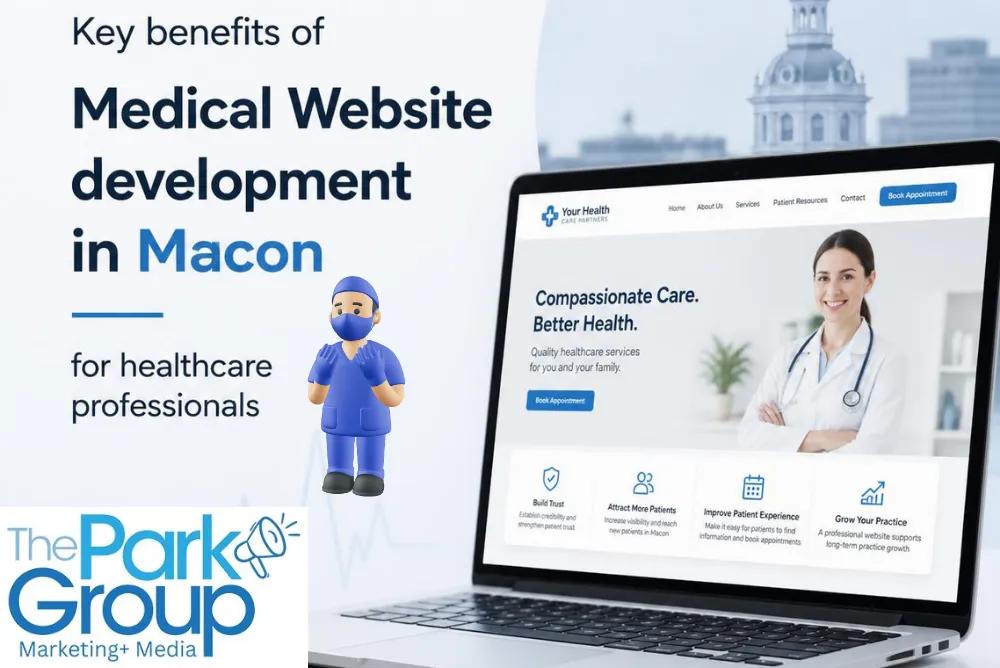
medical website development
Macon, Georgia, is a growing city where residents increasingly use the internet to manage everyday needs, including finding healthcare services. Before contacting a practice, prospective patients may search for its location, medical services, professional credentials, accepted insurance and appointment availability.
This change makes a professional medical website increasingly important. Effective website development in Macon gives healthcare professionals a reliable platform for explaining their services, answering common questions and guiding patients towards an appropriate next step.
A medical website can also help a practice communicate its qualifications and approach to care. However, photographs, testimonials, treatment results and patient information must be presented carefully, with suitable consent and without making misleading medical claims.
Why Does a Healthcare Practice Need a Professional Website?
A website often provides a prospective patient’s first direct experience with a healthcare practice. If the pages look outdated, load slowly or contain incomplete information, the visitor may question whether the details can be trusted.
A modern website should quickly explain:
Which healthcare services are available
Who provides those services
Where the practice is located
When the office is open
How patients can request an appointment
Which insurance plans or payment methods may be accepted
What patients should do if they need urgent medical attention
Clear information can reduce unnecessary telephone enquiries while helping prospective patients decide whether the practice is suitable for their needs.
A Professional Website Can Build Patient Confidence
Healthcare decisions are personal, so patients want reliable information before making contact. Professional biographies can explain each practitioner’s education, licences, experience and clinical interests.
A website may also introduce the practice environment, staff and approach to patient care. Genuine photographs usually create a more credible impression than generic stock images that do not represent the actual team or location.
Patient testimonials and treatment photographs require particular care. A practice should obtain the necessary permission, protect patient privacy and avoid suggesting that every person will receive the same outcome.
Specialist medical website development in Macon can bring these elements together while maintaining an appropriate, professional tone.
User Experience Matters
User experience describes how easily visitors can understand and use a website. Patients should not have to search through several pages to find a telephone number, address or appointment option.
Menus should use familiar labels such as “Services,” “Meet the Team,” “New Patients” and “Contact.” Important actions should remain easy to identify without overwhelming the visitor with pop-ups or competing buttons.
Readable text, clear headings and sufficient spacing are especially important for healthcare audiences. Some visitors may be older, experiencing pain, dealing with impaired vision or trying to find information during a stressful moment.
Accessibility Should Be Included from the Beginning
Healthcare websites should be designed so people with disabilities can access their information and functions. The U.S. Department of Justice explains that the Americans with Disabilities Act applies to the services offered by businesses open to the public, including access provided through websites.
Accessible design may include keyboard navigation, descriptive alternative text for images, labelled form fields, sufficient colour contrast, captions for videos and headings arranged in a logical order. The Department of Justice provides further guidance on web accessibility.
Accessibility should be tested during development and reviewed when new content is added. An automated scan can identify some problems, but it cannot replace careful manual evaluation.
Mobile Design Cannot Be Overlooked
Many prospective patients search for medical services on smartphones. A responsive website should automatically adapt to different screen sizes without requiring users to zoom or scroll sideways.
Telephone numbers should be easy to tap, forms should be manageable on a small screen and directions should open correctly in a mapping application. Buttons also need enough space around them to prevent accidental selections.
Mobile performance matters as well. Oversized images, unnecessary animations and poorly configured scripts can slow down pages, particularly for people using weaker connections.
Online Forms Must Protect Patient Information
Appointment requests and contact forms make it easier for patients to reach a practice, but they can also collect sensitive information. Healthcare organisations should assess what data is genuinely needed and how it will be transmitted, stored and accessed.
HIPAA does not automatically apply to every healthcare-related business or every webpage. When a practice is a covered entity, however, its handling of protected health information must meet applicable privacy and security obligations.
Third-party analytics, advertising pixels and chat tools also need careful review. The U.S. Department of Health and Human Services notes that tracking technology on appointment or symptom-checking pages may access protected health information in some circumstances.
Practices should review the HHS guidance on online tracking technologies with qualified compliance professionals.
Targeted Content Helps Patients Make Informed Decisions
Useful content can address the questions people ask before booking an appointment. A practice might explain what happens during an initial consultation, how to prepare for a procedure or when a particular symptom requires urgent attention.
Every article should be medically reviewed, accurate and updated when guidance changes. The author or reviewer’s credentials should be clear where appropriate, particularly for content discussing diagnoses, treatments or health risks.
Content should educate rather than pressure readers into choosing a procedure. It should also make clear when general information is not a substitute for individual medical advice.
Avoid Unnecessary Medical Jargon
Doctors and healthcare teams regularly use technical language, but prospective patients may not understand it. Unexplained medical terminology can make important information feel intimidating or confusing.
Plain language does not mean removing necessary detail. It means explaining conditions, examinations and treatments in a way that a patient can understand while retaining clinical accuracy.
Short paragraphs, descriptive headings and carefully structured FAQs can make complex subjects easier to follow.
Search Engine Optimisation Supports Local Visibility
A well-designed website cannot help many patients if it is difficult to find. Search engine optimisation helps search engines understand the practice’s services, location and website structure.
Each major service should have its own informative page. Accurate titles, location details, internal links and consistent practice information can help relevant pages appear when people search for healthcare services in Macon.
SEO should never involve repeating keywords unnaturally or publishing thin medical content. Patient-centred information, technical performance and credibility provide a stronger long-term foundation.
Conclusion
A medical website can help Macon healthcare professionals build trust, improve access to information and generate appropriate patient enquiries. Its success depends on more than appearance; accessibility, privacy, mobile performance, clear content and responsible medical communication all matter.
Healthcare practices planning a new website or improving an existing one can contact The Park Group to discuss a professional website aligned with their services, patients and marketing goals.